Enjoying a Tabletop Fireplace Safely: Risks and Precautions
In short:
- A safety standard on the packaging does not rule out every risk of using a tabletop fireplace, because how you use it and where you place it matter just as much. Safety standards mainly cover stability, leak protection and warnings, but they cannot protect you from mistakes in use or a poor choice of spot. Careful handling, good ventilation, safe distances and good-quality fuel are essential to avoid danger.
Many people assume that a safety standard on the packaging rules out every risk. But even with safety standards in place, some risks remain that are easy to underestimate in everyday life. A tabletop fireplace with real flames undeniably brings a lot of atmosphere to your home, but it also brings responsibility. In this article you will learn what really matters for safe use, which mistakes happen most often and how a few clear routines let you relax and enjoy it with peace of mind.
Contents
- What safety standards for tabletop fireplaces cover
- Fire risks and common hazards
- Correct handling: putting out the flame and ventilation
- Ethanol, gel and electric tabletop fireplaces compared
- Your checklist for enjoying your tabletop fireplace safely
- Why safety is more than meeting a standard
- Safety and style with design tabletop fireplaces
- Frequently asked questions about tabletop fireplace safety
Key takeaways
| Point | Details |
|---|---|
| Standards help, but they are not enough | Safety standards reduce risks, but staying alert and using your fireplace correctly remain essential. |
| Know the typical hazards | Flare-ups and too little distance are among the most common causes of accidents. |
| Put out the flame and ventilate correctly | Use the flame regulator or lid, and always make sure the room is well ventilated. |
| Electric fireplaces as an alternative | If you want no open flame and no fire risk, an electric model offers a clear safety advantage. |
What safety standards for tabletop fireplaces cover
With the issue outlined, let us first look at what safety standards for tabletop fireplaces actually do. When people buy a tabletop fireplace, they often rely on standards and labels. That is understandable, but it is worth knowing what these standards cover and where their limits lie.
What the standards regulate
Safety standards for decorative fireplaces that run on liquid fuel focus on stability, leak protection and mandatory warnings. In practice, this means a product is tested to make sure it does not spill fuel if it tips over. The stability of the housing and basic material properties are also part of it.
What the standards do not cover is just as important. They do not set a minimum distance to flammable materials in your particular home. They do not test how you fill the burner or whether you make a common mistake while doing so. A standard tests the product, not the way it is used.
Use this overview as a guide:
| Aspect | Covered by safety standards | Not covered |
|---|---|---|
| Stability | Yes | Where you place it in your home |
| Leak protection | Yes | How much you fill in everyday use |
| Warnings | Yes (mandatory) | Whether the user follows them |
| Safe distance | Partly | Your own furniture |
| Ventilation | No | Room size and window position |
What the manual should tell you
Reputable manufacturers supply complete instructions. These include the maximum amount of fuel, the recommended distance to flammable materials, whether the product is for indoor or outdoor use and how to put out the flame. If the instructions leave these points out, that is a clear warning sign.
Points to check for any fireplace:
- The maximum amount of fuel in millilitres
- The recommended minimum distance to curtains, furniture and walls
- A note to use it only in a well-ventilated room
- Instructions for filling and for putting out the flame safely
- Clear manufacturer details
For a broader look at safety and style with tabletop fireplaces, it is worth reading more about where they can be used, so you know which one really suits your situation.
Fire risks and common hazards
What are the real risks in everyday use, and which mistakes happen most often at home? The good news is that most accidents can be avoided. They are not caused by unknown technical faults but by everyday situations that you can control.

Safe distances and underestimated fire sources
Fire risk and careless refilling are key hazards that are often underestimated at home. A tabletop fireplace burning brightly on the coffee table looks inviting. But a typical living room often has curtains, magazines, textiles and decorations close by.
The problem with safe distances is this. Manufacturers state a minimum distance to flammable materials, but in practice the fireplace often stands on a decorated table with dried flowers, a tray or a table runner right next to it. These seemingly harmless decorations are often highly flammable and can catch fire from the heat or a small spark. Always check the distance in the manual and keep at least one metre between the flame and anything that can burn.
Common, overlooked hazards at home:
- Dried flowers and artificial plants right next to the burner
- Curtains and light fabrics that a draught can blow into the flame
- Paper and magazines on the same table
- Essential oils or scented candles close by
- Low-hanging lampshades made of fabric or paper
Risk of flare-ups when lighting and refilling
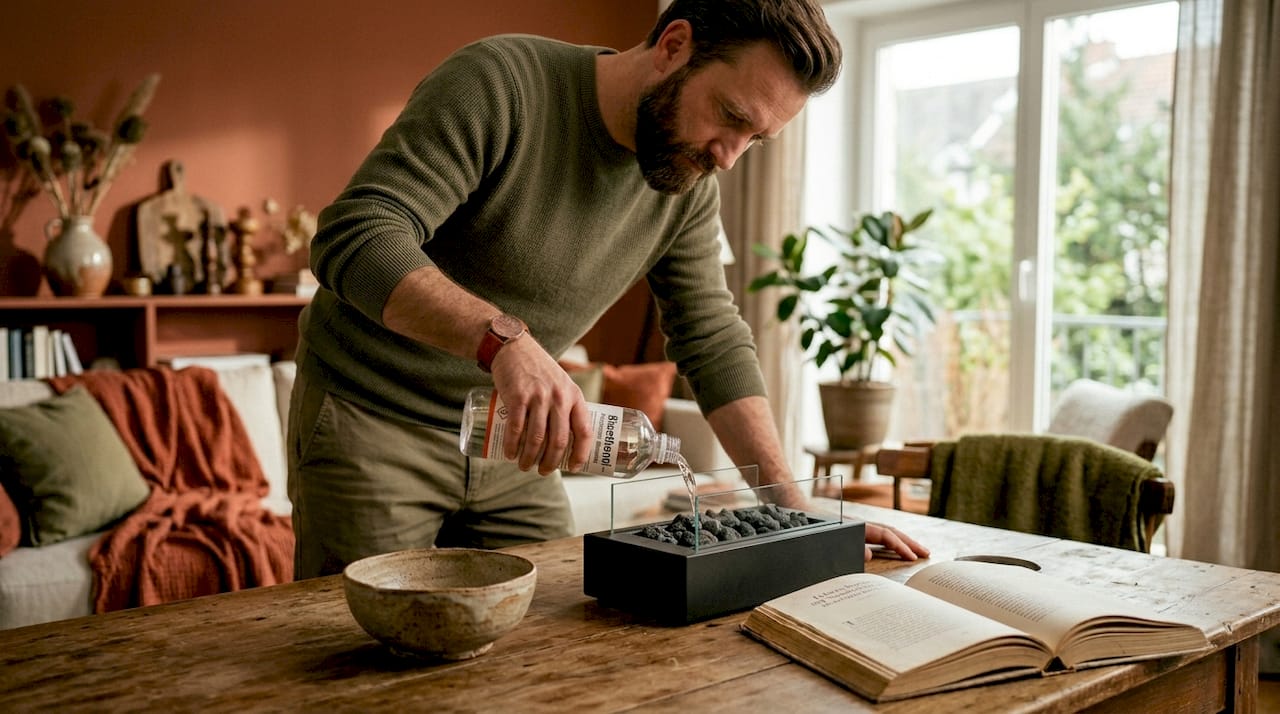
Lighting and above all refilling are especially risky moments. If you pour bioethanol into a burner that is still warm, the fuel vapour can ignite suddenly. This causes a flare-up, a split-second expansion of burning gas. The result can be a jet of flame that appears in a fraction of a second.
"Flare-ups when lighting and when refilling a hot burner are among the most common causes of accidents with ethanol tabletop fireplaces."
That sounds dramatic, but the solution is simple. After putting out the flame, wait at least 15 minutes before refilling the burner. Never fill above the maximum mark. And always light a freshly filled burner with a long lighter or a long match.
Pro tip: always refill bioethanol at room temperature and never while the fire is lit. Put the bottle away straight after filling and keep it well away from the fireplace before you light the flame.
Anyone who is buying a tabletop fireplace, or has been using one for a while, should read our full guide to handling bioethanol tabletop fireplaces safely.
Correct handling: putting out the flame and ventilation
Once you know the hazards, it is vital to know what to do in an emergency and how to keep everyday risks low. A flame that is put out safely matters just as much as a flame that burns safely.
Why water is dangerous
Many people instinctively reach for a glass of water when a flame gets out of control. With a tabletop fireplace that runs on liquid fuel, however, you should never use water to put it out, because water can spread the fire and cause jets of flame.
The reason lies in the physics of the fuel. Ethanol is lighter than water. If you pour water onto a burning ethanol burner, the fuel can spread across the surface of the water and make the area on fire much larger. At the same time, the evaporating water can cause a jet of flame that shoots upwards and sideways.
Step by step: putting out the flame correctly
- Stay calm: panic leads to mistakes. Stay calm and act in a controlled way.
- Use the snuffer: most good tabletop fireplaces have a built-in slider or lid that puts out the flame by cutting off the oxygen. Slide it slowly and fully over the flame.
- Wait until the flame is fully out: make sure the flame is completely out before you open the lid again or touch the area.
- Let it cool down: the burner housing stays hot for some time. Only touch it once it has cooled down completely.
- If the fire spreads: leave the room straight away, close the doors and call the fire brigade.
"In an emergency, never use water. The snuffer or lid of the fireplace is the right way to put it out."
Pro tip: make sure the snuffer of your tabletop fireplace is always easy to reach. Do not put anything in front of or next to the fireplace that could get in the way. Practise using it while the fireplace is cold, so you can do it quickly and safely in an emergency.
Why ventilation is essential
Bioethanol burns relatively cleanly and produces neither smoke nor soot. That is true. But even ethanol that burns "cleanly" produces pollutants if the room is not ventilated well. Burning it produces carbon dioxide and uses up oxygen in the room.
In a small room with the windows closed, the oxygen level can drop noticeably after an hour. You may notice this as a headache, tiredness or stuffy air. Burning ethanol also produces small amounts of carbon monoxide and aldehydes, which can be harmful if you breathe them in over long periods.
Everyday ventilation tips:
- Keep a window slightly open, or open the windows wide for a few minutes every 30 minutes
- Never use a tabletop fireplace in a very small room without ventilation
- Bedrooms are not suitable for ethanol tabletop fireplaces
- If you feel unwell, put out the flame straight away, leave the room and get some fresh air
Find out more in our journal about combining a cosy atmosphere with correct use.
Ethanol, gel and electric tabletop fireplaces compared
To help you decide, it helps to compare the risks and benefits side by side. Not every tabletop fireplace is the same. The type you choose has a direct effect on safety and on how you can use it.
The types explained
Ethanol tabletop fireplaces use liquid bioethanol as fuel. They produce a real, visible flame and give off real warmth. The fuel sits in a built-in burner. The flame is easy to control and looks very natural.
Gel tabletop fireplaces use a gel fuel supplied in tins or cartridges. The flame is also real, but it gives slightly less warmth than ethanol. The gel makes handling a little easier, because less liquid can spill.
Electric tabletop fireplaces imitate a flame with LED technology. They produce no real flame and therefore no risk of burning. Some models have a built-in fan heater, others are purely decorative.
Safety compared
Electric tabletop fireplaces avoid fire risks altogether, while any fireplace with a real flame keeps some residual risk.

| Feature | Ethanol | Gel | Electric |
|---|---|---|---|
| Real flame | Yes | Yes | No (LED) |
| Fire risk | Medium | Medium | Very low |
| Ventilation needed | Yes | Yes | No |
| Warmth | Highest of the three | Medium | Low to medium |
| Safe distance needed | Yes | Yes | No |
| Risk of flare-ups | Possible | Low | None |
| Suitable for bedrooms | No | No | Yes |
| Portability | Very high | High | Medium |
What the comparison shows:
- Ethanol models give the most beautiful real flame and the most warmth, but they need consistent safety routines.
- Gel models are a little easier to handle, but their safety profile is similar.
- Electric models are the simplest choice if you do not need a real flame or have children or pets at home.
If style and function in a tabletop fireplace matter to you, our overview will help you choose.
Your checklist for enjoying your tabletop fireplace safely
Finally, here is everything important at a glance, so you can start enjoying your fireplace safely and relaxed. Meeting a standard never replaces your own safety routine, and the everyday rules always apply.
Before every use: what to check
- Check the spot: keep at least one metre away from curtains, furniture, decorations and anything else that can burn.
- Check the burner for cracks and damage: replace a damaged housing or a leaking burner straight away.
- Check how much fuel you use: never fill above the maximum mark. Less is better than too much. For the Ardente, the maximum is 150 ml per filling.
- Test the snuffer: while the fireplace is cold, check that it works smoothly.
- Check the ventilation: keep a window slightly open or make sure the room can be ventilated.
- Keep children and pets away: place the fireplace out of the reach of children and animals.
Top 5 mistakes to avoid
- Refilling a warm or hot burner: this is the most common cause of flare-ups.
- Putting it out with water: this greatly increases the risk of fire.
- Using it in small, poorly ventilated rooms: this leads to a lack of oxygen and a build-up of pollutants.
- Placing it near decorations: dried flowers, paper and fabrics close to the flame are risky.
- Leaving it burning unattended: a tabletop fireplace should never burn without someone present and awake.
Why you should really read the manual
It sounds obvious, but most people only skim the manual or ignore it completely. Yet it contains important information that differs from model to model. The maximum amount of fuel can vary a lot between burners, and the recommended distances depend on the model.
Pro tip: do not put the manual in a drawer. Keep it somewhere easy to reach, for example next to the fireplace, so you can check it straight away if you have any questions or doubts.
We have also put together our 10 most important bioethanol safety tips in detail, so you do not miss anything important.
Why safety is more than meeting a standard
After the practical checklists, here is our own view on something most guides overlook: the underestimated risk of your own routine.
There is a psychological effect you could call getting used to it. The longer you use a tabletop fireplace without problems, the more careless you are likely to become. That is not a criticism, it is human nature. The first time, you set the fireplace up carefully, check the distances and read the manual. By the twentieth time, you refill the burner without checking whether it has cooled down.
Standards reduce risks, but they do not replace your own safety routine. That sounds simple, but it matters a great deal. A well-made fireplace gives you a solid basis. It does not, however, protect you against mistakes made in everyday use.
It is often not beginners who take risks, because they are still careful. It is people who have used their fireplace for a long time and feel confident. Safety is not something you achieve once and then keep. It is an active attitude that you take on again and again.
In practice, this means treating every refill like the first one. Before you light the flame, take a quick look around the room and ask yourself whether anything is too close. Make it a habit, not a chore. Because if it feels like a chore, sooner or later you will skip it.
Another point that is rarely discussed is fuel quality. Not every bioethanol on sale is equally good. Impurities or the wrong additives can affect how it burns. Always buy fuel that is clearly labelled for decorative and tabletop fireplaces, and never mix it with other substances.
Being safety-conscious does not mean you cannot enjoy your tabletop fireplace. It means using it with the care it deserves, so it gives you many relaxed evenings. You will find more on tabletop fireplace safety in our journal.
Safety and style with design tabletop fireplaces
Now that you know what really matters, you also know how important it is to choose the right product. A tabletop fireplace with clear manufacturer information, a stable burner and a reliable snuffer is the best basis for carefree enjoyment.

At Flaemme you will find modern bioethanol tabletop fireplaces that need no installation, chimney or gas and still give you real, captivating flames. Every model is designed with safety and style in mind, compact, portable and ready to use straight away. They are made for indoor use and for sheltered spots outdoors, whether on the dining table or on a covered terrace. With 30 days of free returns and a 2-year warranty, you can find the right fireplace for your home without any stress. Browse our range at flaemme.com and find your new favourite moment by the fire.
Frequently asked questions about tabletop fireplace safety
Does an ethanol tabletop fireplace use up oxygen, and do I need to open a window?
Yes, tabletop fireplaces with an open flame take oxygen from the air in the room. Ventilation is needed to avoid pollutants and a lack of oxygen, so we strongly recommend opening the windows wide regularly or keeping one slightly open.
Why should you never put out a tabletop fireplace with water?
Water can cause dangerous jets of flame, because the ethanol spreads across the surface of the water and the fire gets bigger. Use the snuffer or the built-in lid of your tabletop fireplace instead.
Do safety standards really prevent accidents?
Standards reduce risks at product level, but they cannot rule out mistakes in handling or placement. They do not fully protect you from accidents, which is why your own safety routine remains essential.
Are electric tabletop fireplaces always safer than ethanol or gel models?
Yes, because they work without an open flame and carry no risk of burning. Electric tabletop fireplaces avoid fire risks, but they do not create the same atmosphere as real flames.