Using a Fireplace as Room Divider: 8 Design Ideas
TL;DR:
- Fireplaces serve as architectural dividers in open-plan homes, providing warmth, visual separation, and spatial boundaries. Double-sided wood or gas models, electric cassette units, and even portable bio ethanol fireplaces can define zones, with placement and design balance key to success. Early planning, adherence to safety codes, and cohesive finishes ensure functional, aesthetically pleasing fireplace room divisions.
Open floor plans are beautiful until you realize every space bleeds into the next with no sense of purpose or intimacy. A fireplace as room divider solves this in the most satisfying way possible. You get real warmth, a living focal point, and a spatial boundary that never feels heavy or oppressive. Fireplaces are increasingly used as architectural dividers in open-plan homes, and once you see how well they work, a plain partition wall starts to feel like a missed opportunity.
Table of Contents
- Key takeaways
- 1. Understanding what makes a fireplace as room divider work
- 2. Double-sided wood-burning fireplaces
- 3. Gas fireplaces with multi-sided views
- 4. Electric cassette fireplaces for subtle division
- 5. Masonry and stone fireplace partitions
- 6. Creative applications across different room types
- 7. Comparing fireplace divider types
- 8. Practical tips for planning your fireplace divider space
- My honest take on fireplace dividers
- Explore fireplace designs that fit your space from Flaemme
- FAQ
Key takeaways
| Point | Details |
|---|---|
| Fireplaces define zones without walls | A double-sided or see-through fireplace creates visual separation while keeping the open feeling intact. |
| Safety codes are non-negotiable | IRC 2024 hearth extension and combustible clearance rules must be met before any inspection sign-off. |
| Both sides must feel intentional | Visual balance across both viewing faces is what makes a fireplace divider feel architectural, not accidental. |
| Furniture placement is part of the design | A minimum 36-inch clearance from hearth to seating applies on both sides of the divider. |
| You have more options than you think | Wood, gas, electric, and cassette models all work as dividers, each with different installation demands and aesthetics. |
1. Understanding what makes a fireplace as room divider work
Before you fall in love with a specific model or finish, it helps to understand the design logic behind fireplace room separation. A fireplace divider is not just a heating appliance placed in the middle of a room. It is a structural and visual anchor that shapes how both sides of the space feel and function.
Double-sided fireplace placement shapes furniture layouts and traffic flow in ways that a single-sided unit simply cannot. When you treat the fireplace as a shared focal point, both rooms organize themselves around it naturally. Seating faces the fire. Pathways open up on the sides. The result feels considered rather than improvised.
The key criteria to get right from the start:
- Visual balance: Both sides of the fireplace should feel equally finished and intentional. Treating one side as primary and the other as secondary is the most common design mistake.
- Safety clearances: IRC 2024 requires hearth extensions of at least 16 inches in front and 8 inches to the sides for openings under 6 square feet, with larger openings requiring 20 inches and 12 inches respectively.
- Combustible trim clearances: Mantels and combustible materials must maintain minimum distances from the firebox opening, and any projection beyond 1.5 inches increases the required clearance.
- Sightlines and proportions: The fireplace should be sized relative to the rooms it divides. A unit that feels grand from the living side but disappears from the dining side has failed as a divider.
- Traffic flow: Both sides need clear pathways around the hearth, with enough room for comfortable movement without weaving around the unit.
Pro Tip: Plan your fireplace placement tips before finalizing your floor plan. Moving structural or masonry elements after framing begins is expensive and often impossible without redesign.
2. Double-sided wood-burning fireplaces
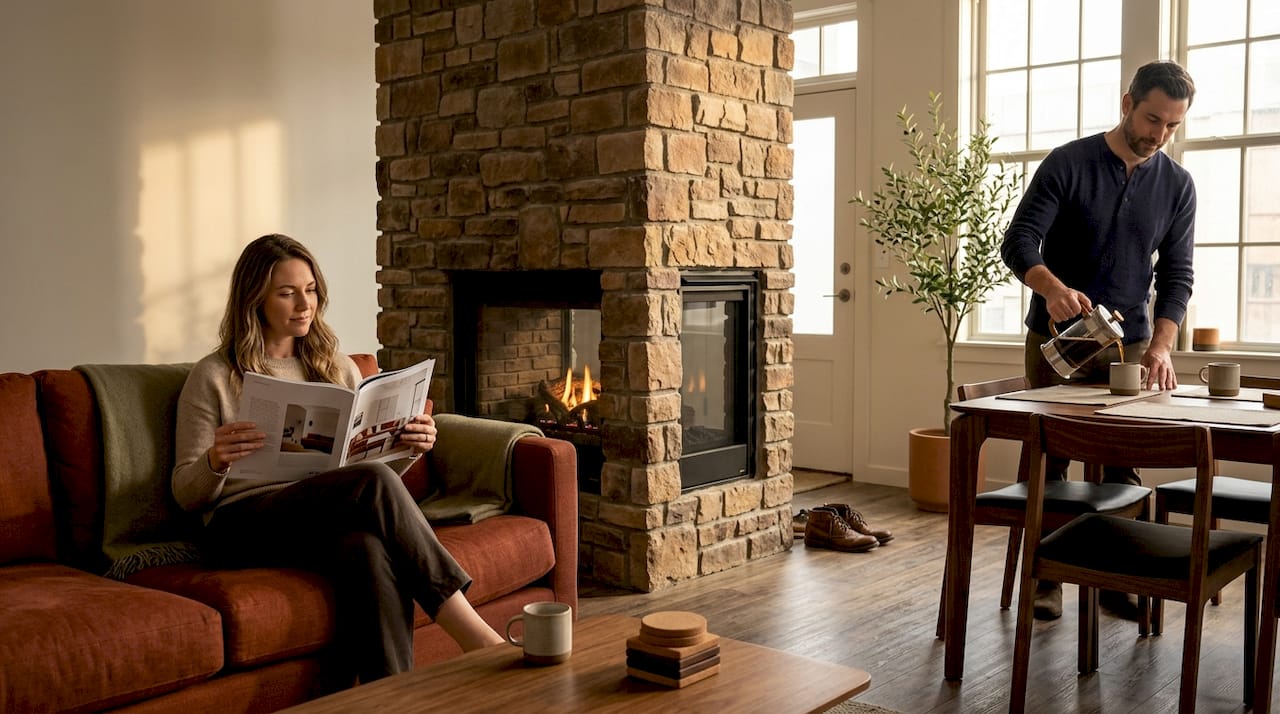
A double-sided wood-burning fireplace is the most architecturally powerful version of this concept. It is built directly into the structure of the home, open on two faces, and visible simultaneously from two rooms. Think of a living room and a study sharing one fire, each with an unobstructed view of the same flame.
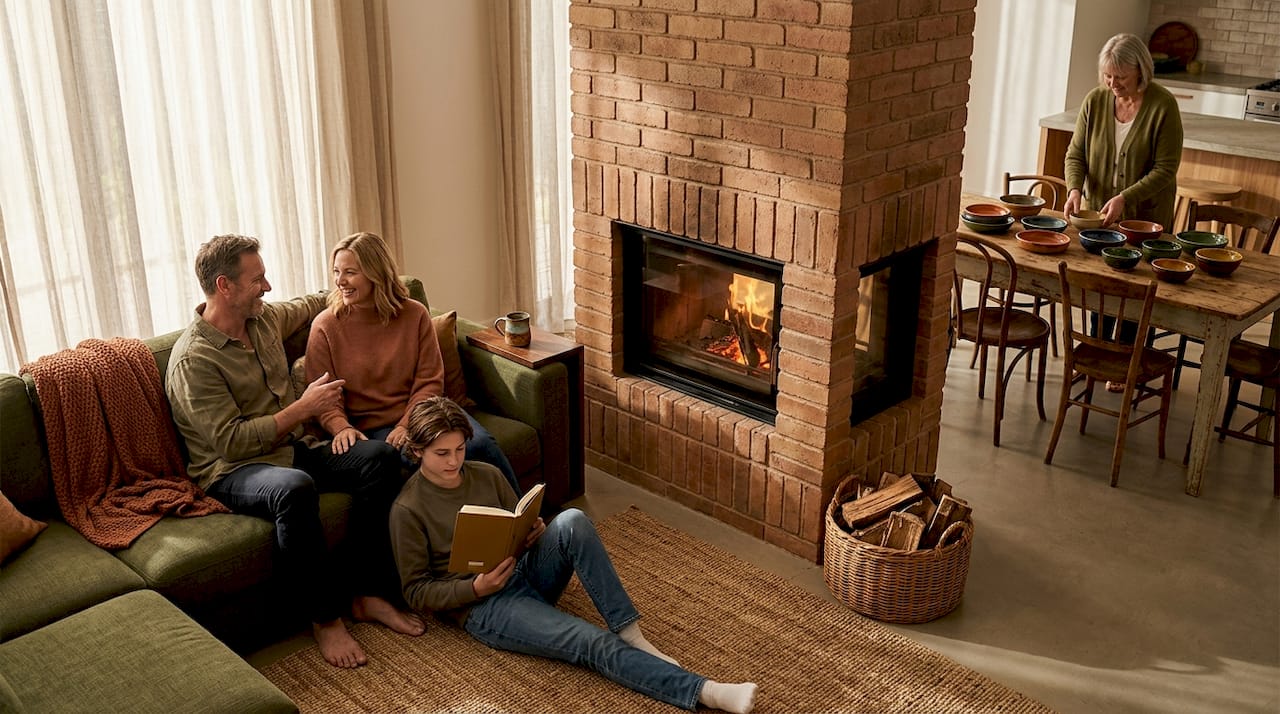
See-through fireplaces serve as visual connectors that link two spaces while preserving each room’s individual character. The challenge is integration. These units need to be planned during the architectural phase, not added after framing. They require a shared chimney or flue system, substantial structural support, and careful planning of combustion air supply.
The aesthetic payoff is significant. Exposed stone or concrete surrounds, matching finishes on both faces, and a generous hearth extension create a piece that feels custom-built rather than installed. This is the option for those who want fireplace room separation to feel like a permanent design statement.
3. Gas fireplaces with multi-sided views
Gas fireplaces offer the warmth and visual appeal of a real flame without the wood storage, ash cleanup, or complex flue requirements of a wood-burning unit. For room division with fireplace design in mind, linear gas models work especially well. Their horizontal format translates across wide openings and reads clearly from multiple viewing angles.
Three-sided gas models, sometimes called peninsula fireplaces, are particularly effective. They wrap the flame on three faces and create a sense of the fire floating within a surround. From one room you see the full front face. From the adjacent space, you catch the side view. The effect is warm and slightly theatrical in a way that feels genuinely cozy rather than showy.
If you want to preview how a horizontal flame reads from across a room before committing to construction, the Flamme Royale™ black rectangular tabletop fireplace gives you that linear fire format at tabletop scale, no venting required.
Gas models also allow more flexibility on placement because the venting options are more varied. Direct-vent gas units can vent horizontally through an exterior wall, which removes the need for a traditional vertical chimney and opens up more interior locations.
4. Electric cassette fireplaces for subtle division
Not every open-plan space calls for a structural installation. Electric cassette-style fireplaces offer a modern fireplace divider option that is far more flexible than masonry or gas. Models with multi-sided views can be open on one to four sides, allowing the fire effect to be seen from multiple rooms without blocking sightlines.
The flame in these units uses water vapor and LED lighting to create a realistic fire effect. There is no heat output unless you want it, making them usable year-round as purely visual elements. For a loft, studio apartment, or open-plan kitchen and living area, this flexibility is genuinely practical.
They also sidestep the structural and code complexities of combustion appliances. No hearth extension requirements. No combustible clearance calculations for the firebox itself. You plug in, position, and enjoy. The tradeoff is that the visual depth and warmth of a real flame are not fully replicated, though premium models come impressively close.
5. Masonry and stone fireplace partitions
If you want the fireplace to function as an actual room partition rather than a floating unit, masonry construction is the approach to consider. A full masonry fireplace divider becomes a wall. It can incorporate shelving, niches, or display surfaces on one or both sides while the firebox sits at its center.
This approach requires significant structural planning. Incorrect measurement and finish material thickness are the most frequent causes of inspection failure in masonry installations. The finish tile or stone you apply over the hearth substrate reduces the measurable extension length, and inspectors measure the final installed dimension, not the substrate.
For masonry dividers, coordination between masonry, framing, and finish carpentry is where most code violations appear. The mantel and trim installation stage is when clearance distances tend to shrink because those decisions often happen after the main structure is already signed off.
6. Creative applications across different room types
The most inspiring uses of a decorative fireplace room barrier tend to cross room categories in ways that feel genuinely unexpected.
- Living room and dining room: A double-sided unit centered on the shared wall creates a warm, candle-like atmosphere for dining on one side and a cozy anchor for lounging on the other. Both rooms benefit from the same fire without either feeling secondary.
- Primary suite and bathroom: A see-through fireplace between the bedroom and a freestanding tub is one of the most atmospheric applications possible. The visual continuity between the two spaces feels luxurious and considered.
- Indoor-outdoor transitions: A fireplace set into a glass wall or sliding door surround can be viewed from inside and from an adjacent terrace. The fire becomes a visual and thermal connector between interior comfort and outdoor space.
- Kitchen and living area: An electric cassette unit in a low-profile surround subtly marks the boundary between the cooking zone and the seating area without blocking light or creating visual weight.
- Home office and lounge: A double-sided gas unit creates a sensory boundary between focus space and relaxation space without requiring separate rooms or solid walls.
Pro Tip: When balancing scale across two rooms, size the fireplace to the smaller of the two spaces. A unit that feels proportionate in a compact dining area will still read well in a larger living room, but the reverse rarely works.
7. Comparing fireplace divider types
| Type | Visual openness | Installation complexity | Best suited for |
|---|---|---|---|
| Double-sided wood | High | Very high | Architectural, new-build projects |
| Gas (linear or peninsula) | High | Moderate to high | Renovation and new-build |
| Electric cassette | Very high | Low | Rentals, apartments, flexible layouts |
| Masonry partition | Low to moderate | Very high | Permanent, statement installations |
A few additional points worth considering when making your choice:
- Cost: Masonry and built-in gas units involve the highest upfront cost and the most trade coordination. Electric cassette models are the most accessible entry point.
- Maintenance: Wood-burning fireplaces require annual chimney servicing and regular ash removal. Gas units need periodic burner checks. Electric models need almost none.
- Resale value: Built-in gas and masonry fireplaces consistently add perceived value to a home. Electric cassette units are less permanent and may be removed if you move.
- Safety compliance: Combustion fireplaces (wood and gas) require code-compliant installation with hearth extensions, combustible clearances, and inspections. Electric units bypass most of these requirements.
8. Practical tips for planning your fireplace divider space
Getting the design right on paper is one thing. Making it work once the furniture is in and people are using the space is another. Here are the most useful practical guidelines:
- Maintain a minimum 36 inches between any furniture piece and the hearth edge on either side of the divider.
- Plan seating arrangements on both sides before committing to a fireplace location. A unit placed slightly off-center on one side can look intentional; the same unit awkward relative to furniture will look like an error.
- Match finishes across both faces. Surround materials, hearth tile, and mantel profiles should feel cohesive from either viewing side.
- Confirm inspection and permit requirements early. For masonry and gas units, local authority sign-off is required before framing is closed in.
- Consider the HVAC implications. A fireplace that generates real heat in the center of an open plan space may create uneven temperature distribution. Discuss this with your HVAC contractor before installation.
Pro Tip: Get your fireplace layout approved by your local building department before any framing starts. Discovering a code issue after the surround is tiled is a costly and avoidable problem.
My honest take on fireplace dividers
I’ve seen a lot of open-plan spaces with fireplaces added as afterthoughts, and the results are rarely satisfying. The fire ends up shoved against an exterior wall, surrounded by furniture pointing in too many directions, with no clear sense of where one room ends and another begins.
What I’ve learned from watching successful installations is that proportion, placement, and visual balance are not secondary concerns. They are the whole project. When both sides of a double-sided fireplace feel equally finished and equally considered, something genuinely transformative happens to the space. It stops feeling like one big room with a fire in it and starts feeling like two warm, purposeful spaces that happen to share something beautiful.
The most common pitfall I see is treating the fireplace as a feature that can be positioned after the layout is decided. It cannot. The fireplace in an open-plan space is the layout. Everything else organizes around it. When clients understand that early, the results are consistently better.
If you are weighing whether to commit to a built-in unit or explore a more flexible option first, that instinct to start smaller is worth trusting. You can test the spatial logic of using a fireplace as partition with a portable or tabletop unit long before you commit to anything structural.
— V&M
Explore fireplace designs that fit your space from Flaemme
If you are inspired by the idea of using fire to create warmth and definition in your home, Flaemme offers a range of modern bio ethanol tabletop fireplaces that let you experiment with fireplace layout and design before committing to anything permanent. No installation, no chimney, no gas. Just a real flame, ready when you are.
Browse our tabletop fireplaces to feel how a portable flame changes the atmosphere of a space. The Flamme Royale™ black rectangular fireplace suits linear, divider-style arrangements, or explore the larger Ardente™ XL concrete model for a wider, more architectural flame. Whether you are planning a full architectural installation or simply want to create a cozier sense of zones in your home today, Flaemme’s smokeless, stylish designs are a beautiful starting point. Free delivery across Europe and a 30-day return policy make it easy to try. →
FAQ
What is a fireplace as room divider?
A fireplace used as a room divider is a double-sided or multi-sided unit positioned between two spaces in an open floor plan, providing warmth and a visible flame from both sides while creating a sense of spatial separation without a solid wall.
What type of fireplace works best as a room divider?
Double-sided gas or wood-burning fireplaces offer the most architectural impact, while electric cassette models provide the most flexibility with minimal installation requirements. The best choice depends on your budget, existing structure, and how permanent you want the solution to be.
Do fireplace room dividers require special building permits?
Yes, any combustion-based fireplace (wood or gas) requires permits and must meet local building codes, including IRC 2024 hearth extension and combustible clearance requirements. Electric models generally do not require permits but should still comply with electrical codes.
How far should furniture be from a fireplace divider?
Maintain a minimum of 36 inches of clearance between any seating or furniture and the hearth edge on either side of the fireplace. This satisfies both safety requirements and comfortable ergonomic spacing.
Can an electric fireplace work as a room divider?
Yes. Electric cassette-style fireplaces with multi-sided viewing panels can be positioned between rooms to create visual separation and ambient warmth without any structural changes, making them a practical option for apartments, rentals, or flexible living spaces.