Artikel: What Is a Closed Fireplace? How It Works and Its Benefits
What Is a Closed Fireplace? How It Works and Its Benefits
In short:
- A closed fireplace reaches a high efficiency of up to 85 per cent and can be used without legal time limits. Compared with an open fireplace it offers more safety, lower emissions and better heat efficiency. Retrofitting is possible, but it needs professional installation and the right approvals.
A closed fireplace is a fireplace with a fire-resistant glass door that fully seals the combustion chamber, allowing the fire to burn in a controlled way. This design raises efficiency considerably compared with an open fireplace and turns it into a genuine source of heat rather than just a decorative feature. For homeowners in Germany, Austria and Switzerland this matters more than ever, as emission rules and rising energy costs call for clear answers.
What is a closed fireplace and how is it different?
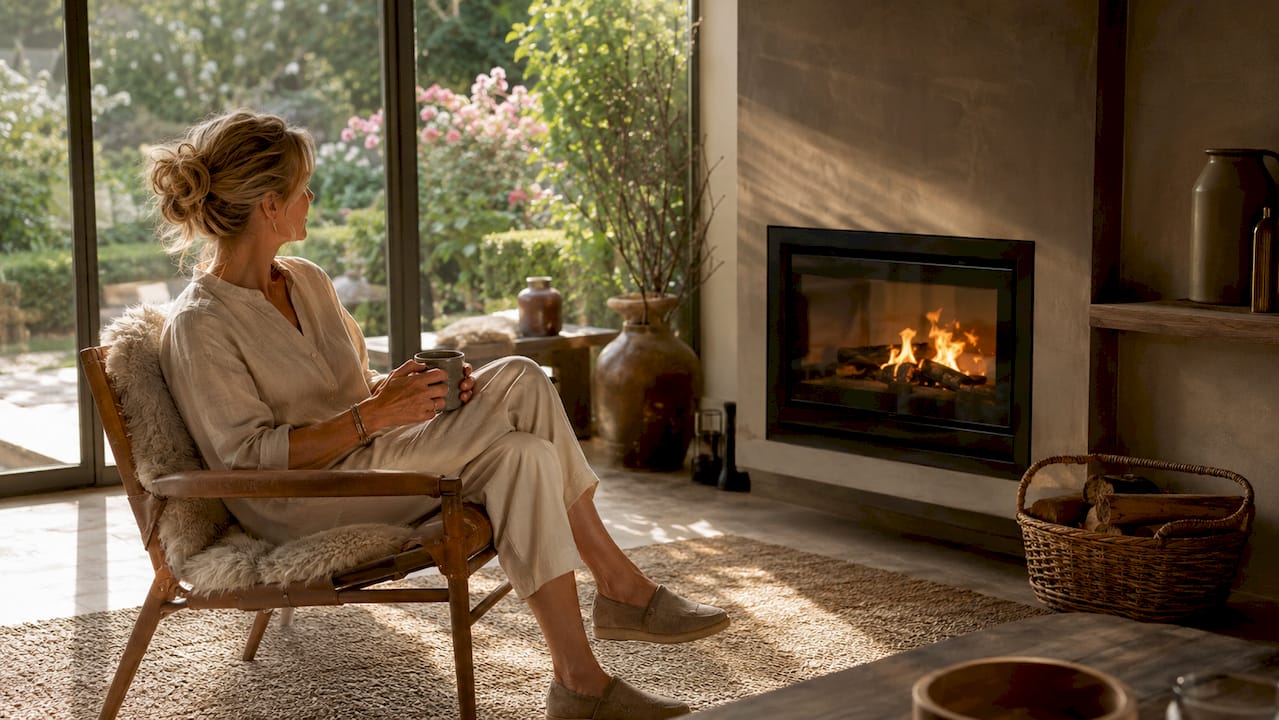
A closed fireplace, known in the trade as a wood-burning stove or fireplace insert, consists of a sealed combustion chamber with a viewing window made of fire-resistant glass. The glass separates the fire from the room and also protects against flying sparks. The key difference from an open fireplace is the controlled air supply: you decide how much oxygen reaches the fire, and so how efficiently the fuel burns.
"Wood-burning stove" is the usual term for freestanding closed appliances. A "fireplace insert" or "fireplace cassette", on the other hand, is a unit that is fitted into an existing open fireplace. Both work on the same principle and offer the same advantages over an open design.
Open fireplaces lose 80–90 % of their heat up the chimney. Closed systems make far better use of that energy. In practice, the same amount of wood keeps your living space noticeably warmer for longer.

How does a closed fireplace work?
A closed fireplace relies on two separate airflows that together produce clean and efficient combustion. Once you understand this principle, you will be able to use and look after your fireplace much better.

Primary and secondary air working together
Primary air enters the combustion chamber from below and supplies the fire with the oxygen it needs for the main burn. Secondary air flows in from above or from the side and burns off any flue gases that have not fully combusted. This afterburn can raise efficiency by up to 15–20 %. The result is less soot, fewer fine particles and more heat per kilogram of wood.
Airwash: a clear view of the fire
One particularly clever detail is the airwash system. The fireplace guides a thin curtain of air down the inside of the glass. This airflow stops soot and combustion residue from clouding the glass. Airwash only works reliably, however, if you burn dry wood with less than 20 % moisture. Damp wood produces more tar and soot than even the best air curtain can keep away.
The key technical features at a glance:
- Sealed combustion chamber with fire-resistant glass for a safe view of the flames
- Adjustable air supply via sliders or dials for primary and secondary air
- Airwash for a clear view and clean combustion
- Insulated chamber walls made of firebrick or vermiculite for even heat output
- Chimney connection via a flue pipe for safe removal of smoke
Pro tip: Buy a wood moisture meter for under 20 euros. Measure your firewood before it goes in. If the reading is above 20 %, leave the wood to season for a few more weeks. Dry wood saves fuel and is kinder to your chimney.
Closed fireplace vs open fireplace: what are the differences?
In almost every category the comparison between a closed and an open fireplace is clear-cut. Open fireplaces are full of atmosphere but barely work as a source of heat. A closed fireplace reaches efficiencies of 60–85 %, while an open fireplace keeps only 10–20 % of the heat it produces in the room.
The main differences at a glance
| Criterion | Open fireplace | Closed fireplace |
|---|---|---|
| Efficiency | 10–20 % | 60–85 % |
| Heat loss | 80–90 % up the chimney | Much lower |
| Flying sparks | High risk | No risk thanks to the glass |
| Fine particle emissions | High | Significantly lower |
| Permitted use | Max. 8 days/month, 5 hrs/day | No legal limit |
| Maintenance | High (lots of soot) | Lower |
| Installation effort | None (already in place) | Medium to high |
Legal restrictions on open fireplaces
This point surprises many homeowners: open fireplaces may only be used within legal limits. In Germany open fireplaces are restricted to a maximum of 8 days per month and up to 5 hours per day. Closed fireplaces are not subject to these restrictions. For you as a homeowner, that means anyone who wants to use their fireplace regularly and without limits will find it hard to avoid a closed system.
The safety advantages should not be underestimated either. Flying sparks from an open fireplace are a real fire risk, especially with rugs or wooden floors nearby. The sealed glass door of a stove removes this risk completely. If you are thinking about low-smoke fireplace solutions for your home, you will find more ideas for safe alternatives there.
What are the benefits of a closed fireplace for homeowners?
A closed fireplace is not only more efficient, it also improves indoor air quality and makes everyday use safer. Controlled airflow keeps the air in the room cleaner while you still get to watch the flames. It is a benefit many homeowners only truly appreciate after making the switch.
The practical benefits at a glance:
- Lower heating costs: An efficiency of up to 85 % means you need less wood for the same amount of heat. You see that straight away in your fuel costs.
- Fewer fine particles: Thanks to the sealed chamber, closed fireplaces significantly reduce flying sparks and fine particle emissions. That protects your health and your family's.
- Less maintenance: Modern fireplace cassettes reduce soot build-up in the chimney significantly. Less soot means fewer visits from the chimney sweep and lower maintenance costs.
- Fire protection: The sealed glass door stops flying sparks completely. That is especially important in rooms with wooden floors, rugs or furniture close to the fireplace.
- Unlimited use: No legal restrictions on use as with open fireplaces. You can light the fire whenever you like.
Pro tip: When buying, check the efficiency rating on the appliance's rating plate. An efficiency below 70 % should no longer be acceptable for a new purchase today.
How do you retrofit an open fireplace, and what does it cost?
Retrofitting an open fireplace with a fireplace cassette or insert is one of the most effective upgrades a homeowner can make. It turns a purely decorative fireplace into a genuine, efficient source of heat. Retrofits require approved fireplace cassettes that fit precisely and are properly sealed, so that you get the efficiency gains and meet the legal requirements.
Retrofitting step by step
-
Assessment by the chimney sweep: Have your chimney inspected. Not every chimney is suitable for a closed fireplace. The cross-section, height and condition of the chimney determine which cassette will fit.
-
Choosing the right cassette: The cassette has to fit the opening of your existing fireplace exactly. Made-to-measure units are the rule here, not the exception. Make sure it has a valid approval under EN 13229.
-
Professional installation: To meet emission rules, an approved cassette that fits precisely is essential. Installation should be carried out by a certified stove fitter, who then has the installation signed off by the chimney sweep.
-
Sign-off and first use: After installation the chimney sweep checks the system for leaks and emission levels. Only after this sign-off may the fireplace be used normally.
Costs and benefits of retrofitting
| Item | Approximate cost |
|---|---|
| Fireplace cassette (standard) | €800–2,500 |
| Professional installation | €500–1,500 |
| Chimney sweep sign-off | €100–300 |
| Total cost | €1,400–4,300 |
The investment pays for itself through lower heating costs and less maintenance. If you use your fireplace regularly, the higher efficiency saves you a noticeable amount on fuel every year. For more on energy-saving fireplace solutions, it is worth looking at a current practical guide.
Care and use
Closed fireplaces produce fewer emissions and need less chimney maintenance, but regular care still matters. Remove the ash every two to three days of use, once it is more than two centimetres deep. Clean the glass when needed with a dedicated stove glass cleaner. Have the chimney swept once a year, even though there is far less soot than with an open fireplace.
Key takeaways
A closed fireplace is the most efficient and safest solution, with no legal time limits, for homeowners who want real warmth combined with the experience of a living fire.
| Point | Details |
|---|---|
| Efficiency | Closed fireplaces reach 60–85 %, open ones only 10–20 %. |
| Legal use | Open fireplaces are limited to 8 days per month, closed ones are not. |
| Retrofitting | Fireplace cassettes must be approved and professionally installed. |
| Fuel quality | Wood with less than 20 % moisture is a must for clean combustion. |
| Safety | The glass door stops flying sparks and removes that fire risk entirely. |
My view: why a closed fireplace is more than a heater
Over the past few years I have met many homeowners who see their open fireplace as the essential highlight of the living room. And I completely understand that. The crackle, the flicker, the atmosphere. But the truth is that an open fireplace mainly heats the chimney, not the room.
What really convinces me about closed fireplaces is not just the efficiency on paper. It is the combination of safety, everyday practicality and keeping the experience of the fire. You see the flames just as beautifully through the glass. But you do not lose 80–90 % of the heat up the chimney, and you do not risk a spark landing on the parquet.
What many people underestimate is that a closed fireplace is also an upgrade for the air you breathe. Controlled combustion means fewer fine particles and fewer pollutants in your living space. That matters most for families with children or anyone with a respiratory condition.
My honest advice: if you have an open fireplace and want to use it more than twice a month, retrofitting a fireplace cassette is almost always worth it. Get advice from a certified stove fitter before you buy. The costs are manageable and the gain in comfort and safety is considerable. If you do not have a fireplace yet and want flexibility, it is also worth considering modern fireplace alternatives without a chimney.
— V&M
Fire without compromise: how Flaemme does it
You now know how a closed fireplace works and what it offers. But what if you want to enjoy the atmosphere of a real fire without installation, a chimney or a permit? That is exactly where Flaemme comes in.

Flaemme offers modern bioethanol tabletop fireplaces that are ready to use straight away, need no chimney and burn without smoke. They produce a real flame that brings atmosphere to your living room or to a sheltered patio or balcony. No installation, no permit, no compromise on design. Discover Flaemme's smokeless tabletop fireplaces and find the model that suits your home. One filling of up to 150 ml burns for 60 to 90 minutes, with 30 days of free returns and a 2-year warranty included.
FAQ
What is the difference between a wood-burning stove and a fireplace insert?
A wood-burning stove is a freestanding appliance with a sealed combustion chamber. A fireplace insert or cassette is fitted into an existing open fireplace and turns it into a closed system.
How efficient is a closed fireplace?
Closed fireplaces reach efficiencies of 60–85 %, while open fireplaces keep only 10–20 % of the heat they produce in the room.
Do I need approval for a closed fireplace?
Yes. In Germany it must be installed by a certified professional and then signed off by the chimney sweep. The fireplace cassette itself needs a valid approval, for example under EN 13229.
How often do I need to clean a closed fireplace?
Remove the ash every two to three days of use. Clean the glass with stove glass cleaner when needed. The chimney is inspected and swept once a year by the chimney sweep.
Can every open fireplace be retrofitted with a cassette?
Not every one. The chimney needs the right cross-section and must be in good condition. Having it checked by a chimney sweep before you buy is strongly recommended.