What Is Emission-Free Heating? A Guide for Homeowners
TL;DR:
- Emission-free heating involves warming homes without on-site fossil fuel combustion, relying on renewable electricity or heat sources. Technologies like heat pumps, solar thermal, and district heating are key options, with policy efforts accelerating their adoption across the DACH region. The environmental benefits extend beyond zero local emissions, improving air quality and reducing greenhouse gases over time as grids decarbonize.
Emission-free heating is defined as providing warmth in your home without burning fossil fuels or releasing direct CO2 at the point of use. Technologies like heat pumps, geothermal systems, solar thermal collectors, and electricity from renewable or nuclear sources all qualify under this definition. For homeowners and renters across Germany, Austria, and Switzerland, understanding what is emission-free heating has become more than an environmental question. It is a practical decision shaped by rising energy costs, tightening regulations, and a genuine desire to live more sustainably.
What is emission-free heating and how does it work?
Emission-free heating is thermal energy provision without fossil-fuel combustion, using ambient heat and clean electricity instead. No gas burner, no oil boiler, no direct carbon release inside your home. The industry term you will encounter in technical and policy contexts is carbon-free heating or clean heating, and both phrases describe the same core principle.
The distinction between direct and lifecycle emissions matters here. A heat pump running on electricity from a coal-heavy grid still produces zero emissions at your radiator, but significant emissions exist upstream at the power plant. Emission boundaries must be clearly defined to avoid consumer misconceptions when comparing technologies. This is why the source of your electricity is just as important as the heating device itself.
For renters and homeowners in the DACH region, this nuance is practical, not academic. Germany’s electricity mix is shifting toward renewables, and Austria already sources over 70% of its electricity from hydropower. The cleaner your grid, the cleaner your electric heating becomes automatically, without any changes to your equipment.
Which technologies enable emission-free heating at home?
Several proven technologies make clean heating achievable today, each suited to different home types, budgets, and locations.
Heat pumps: the leading solution
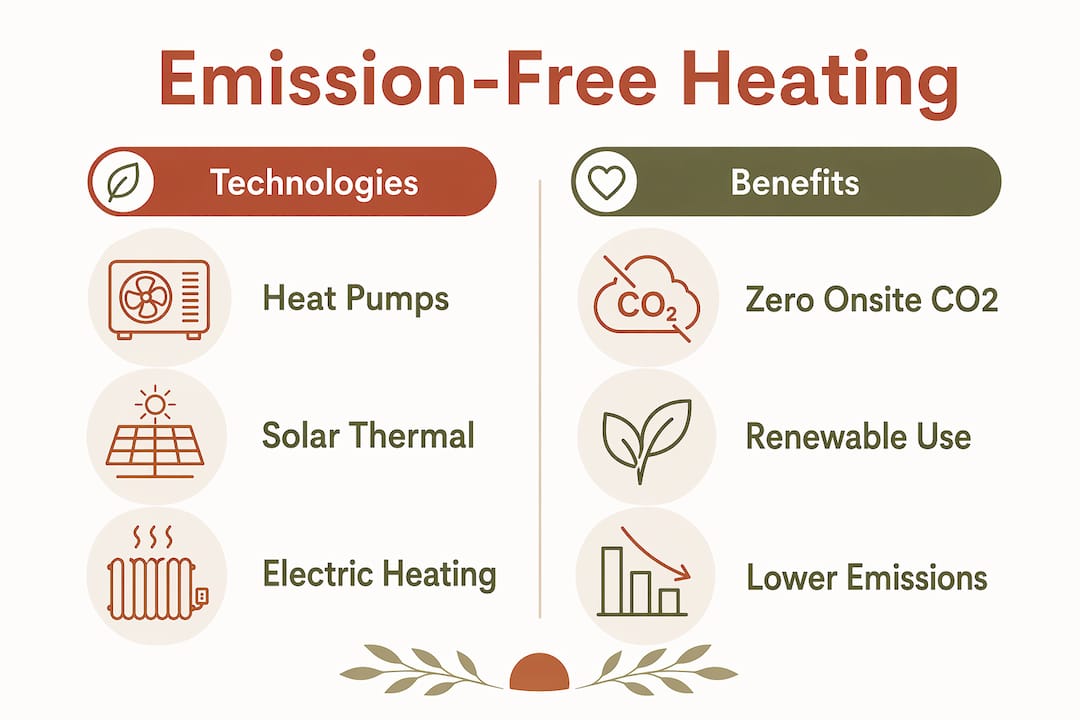
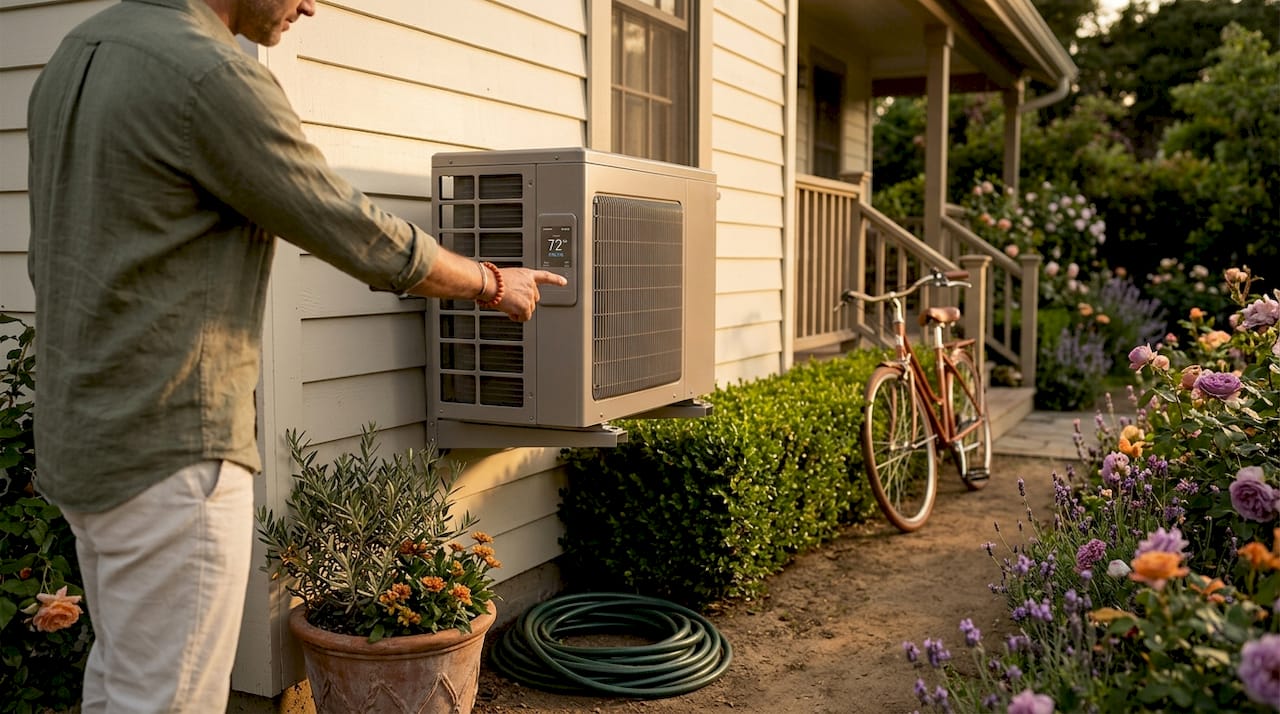
Heat pumps replace combustion with electricity to transfer ambient heat from air, ground, or water into your home. Air-source heat pumps are the most accessible option for existing homes because they require no ground excavation. Ground-source (geothermal) heat pumps deliver higher efficiency but involve significant installation work and upfront cost. Both types produce zero direct emissions and, when powered by renewable electricity, achieve near-zero lifecycle emissions as well.
Solar thermal and geothermal systems
Solar thermal systems use roof-mounted collectors to capture the sun’s heat and transfer it to water for space heating or domestic hot water. They work well in combination with a heat pump or a backup electric heater. Geothermal systems tap stable underground temperatures year-round, making them particularly reliable in colder climates like those found in Alpine regions of Austria and Switzerland.
Electric heating powered by clean electricity
Direct electric heating, including infrared panels and electric radiators, produces zero onsite emissions. Whether it qualifies as truly emission-free depends entirely on the electricity source. In Austria and Switzerland, where grids are predominantly renewable, electric heating is effectively emission-free today. In Germany, the answer is more nuanced but improving each year as coal capacity is retired.
Here is a comparison of the main emission-free heating solutions available to DACH homeowners:
| Technology | Efficiency | Upfront cost | Best suited for |
|---|---|---|---|
| Air-source heat pump | High (COP 3 to 4) | Moderate | Most existing homes |
| Ground-source heat pump | Very high (COP 4 to 5) | High | Homes with outdoor space |
| Solar thermal | Medium | Moderate | Supplementary heating |
| Direct electric heating | 100% conversion | Low | Well-insulated apartments |
| Bio ethanol fireplace | Supplementary warmth | Low | Renters, no installation |
Pro Tip: If you rent your home and cannot install a heat pump, a bio ethanol tabletop fireplace like those from Flaemme provides real-flame warmth with no chimney, no gas, and no CO2 from fossil fuels. It is a practical supplementary option while you wait for your building to upgrade its main heating system.
How does district heating fit into emission-free heating strategies?
District heating is widespread across German, Austrian, and Swiss cities. It delivers heat generated at a central plant through insulated underground pipes directly into homes and apartment buildings. For renters especially, this is often the only heating system available, making its emissions profile critically important.
The challenge is that many district heating systems still depend on fossil fuels, particularly natural gas and coal, which means they are not yet emission-free. The good news is that the infrastructure itself is not the problem. The heat source is. Replacing fossil fuel boilers with renewable energy, industrial waste heat, or even nuclear heat transforms the same pipe network into a clean heating system.
The Haiyang nuclear plant in China offers a striking example. It supplies carbon-free heat to a city of over 200,000 residents, eliminating coal burning and measurably improving local air quality. This demonstrates that nuclear-driven district heating can deliver near-zero emissions at scale, a model that several European cities are now studying seriously.
For district heating to become truly clean, systems must lower grid temperatures and integrate smarter controls. Lower-temperature networks can accept heat from solar collectors, heat pumps, and industrial waste sources that would otherwise be incompatible with older high-temperature infrastructure. Key upgrades required include:
- Lowering supply temperatures from 90°C to below 60°C to enable waste heat integration
- Installing smart metering and demand-response controls
- Connecting large-scale heat pumps or solar thermal fields to the central plant
- Phasing out gas boilers in favor of electric or renewable heat sources
If you live in an apartment connected to district heating in Vienna, Berlin, or Zurich, the emissions from your heating are largely outside your direct control. Engaging with your building manager or local utility about their decarbonization timeline is the most effective step you can take.
What policies are shaping clean heating adoption in the DACH region?
Policy frameworks are accelerating the shift to emission-free heating across Europe, and the DACH region sits at the center of this transition. Clean heat standards use two approaches to drive decarbonization: mandating the installation of specific low-carbon equipment, and setting outcome-based targets for actual emissions reductions. Both approaches affect manufacturers, energy suppliers, and homeowners directly.
Germany’s Building Energy Act (GEG) requires new heating systems in existing buildings to run on at least 65% renewable energy from 2024 onward. Austria’s renovation programs offer subsidies of up to 75% for heat pump installations. Switzerland’s cantonal energy laws increasingly restrict new fossil fuel heating installations. These are not distant future policies. They are active regulations shaping purchasing decisions today.
The choice of metrics in policy design matters more than most homeowners realize. A policy that counts heat pumps installed rewards volume. A policy that measures emissions avoided rewards performance. The difference shapes how contractors advise you, which products manufacturers prioritize, and how quickly the overall system decarbonizes.
Here is a practical overview of how policy affects your options as a homeowner or renter:
- Check subsidy eligibility before purchasing. Germany’s BEG program, Austria’s Raus aus Öl und Gas initiative, and Swiss cantonal grants can cover a substantial portion of heat pump installation costs.
- Understand your building’s energy certificate. The Energieausweis in Germany and Austria signals how much insulation improvement is needed before a heat pump operates efficiently.
- Ask your landlord about the heating roadmap. Under the GEG, landlords in Germany face legal obligations to transition away from fossil fuel heating, which affects your long-term energy costs as a renter.
- Factor in carbon pricing. Germany’s CO2 levy on gas and heating oil increases every year, making fossil fuel heating progressively more expensive relative to clean alternatives.
Pro Tip: In Germany, the CO2 cost of heating oil and gas is split between landlord and tenant based on the building’s energy efficiency rating. A poorly insulated building means your landlord pays a larger share. Knowing this gives you a useful conversation starter about building upgrades.
What are the real benefits of emission-free heating for your home?
The benefits of emission-free heating extend well beyond the environmental. For homeowners and renters in the DACH region, the practical advantages are increasingly compelling.
Environmental and health benefits are the most visible. Eliminating fossil fuel combustion removes nitrogen oxides and particulate matter from your indoor and local air, not just CO2. Homes heated with heat pumps or clean electricity have measurably better indoor air quality than those with gas boilers. For families with children or anyone with respiratory sensitivities, this is a direct quality-of-life improvement.
Economic advantages are growing as energy prices remain volatile. Heat pumps deliver three to five units of heat for every unit of electricity consumed, making them significantly more efficient than any combustion system. Combined with falling electricity prices from expanding renewable capacity, the running costs of clean heating are on a downward trajectory that gas and oil cannot match.
Practical considerations vary by home type. A detached house in Bavaria has more options than a rented apartment in Vienna. Key factors to assess include:
- Available outdoor space for an air-source or ground-source heat pump
- Current insulation quality, since heat pumps perform best in well-insulated homes
- Whether your building is connected to district heating and its decarbonization timeline
- Your lease terms, which may restrict permanent installations
For renters with no ability to modify their heating system, clean-burning supplementary options like bio ethanol fireplaces offer a meaningful way to add warmth and atmosphere without fossil fuels, installation, or landlord approval.
A common misconception worth addressing directly: electric heating is not automatically emission-free. It depends on the electricity source. In Austria and Switzerland, it effectively is. In Germany, it is partially clean today and becoming cleaner each year. The answer to “is electric heating emission-free?” is: it depends on your grid, and that grid is improving.
Key takeaways
Emission-free heating is achievable for most DACH homeowners today through heat pumps, clean electricity, or district heating powered by renewable and waste heat sources.
| Point | Details |
|---|---|
| Core definition | Emission-free heating produces no direct CO2 at the point of use, relying on clean electricity or renewable heat. |
| Technology choice matters | Heat pumps are the most efficient option; direct electric heating works best in well-insulated, renewable-grid homes. |
| District heating is transitioning | Many DACH district systems still use fossil fuels but are being upgraded with renewables and waste heat integration. |
| Policy is accelerating change | Germany’s GEG, Austrian subsidies, and Swiss cantonal laws are actively pushing homeowners toward clean heating now. |
| Renters have options too | Bio ethanol fireplaces and supplementary electric heating provide emission-free warmth without installation or landlord approval. |
Why the “emission-free” label deserves more scrutiny
The term emission-free heating is genuinely useful, but it can obscure as much as it reveals. After spending time with the research on clean heat standards and district heating transitions, the thing that stands out most is how much the definition depends on where you draw the boundary.
A heat pump running on German grid electricity in 2026 is cleaner than a gas boiler, but it is not emission-free in any complete lifecycle sense. A bio ethanol fireplace burns a carbon-neutral fuel and produces no fossil CO2, but it still produces combustion byproducts. Nuclear district heating delivers near-zero local emissions but carries upstream considerations that reasonable people weigh differently.
What I find most useful is to stop asking “is this emission-free?” and start asking “how much cleaner is this than what I have now, and what is the trajectory?” The DACH region’s energy mix is moving in one direction. Every heat pump installed today becomes cleaner automatically as the grid decarbonizes. That compounding improvement is the real argument for acting now rather than waiting for a perfect solution.
The homeowners I find most informed are those who combine a good technology choice with an understanding of their local grid, their building’s insulation quality, and the subsidies available to them. None of those three factors alone is sufficient. Together, they make the transition genuinely worthwhile.
— V&M
Discover emission-free heating solutions with Flaemme

Flaemme specializes in modern, smokeless bio ethanol tabletop fireplaces that bring real-flame warmth to any space without installation, chimneys, or gas. Whether you are a renter looking for an eco-friendly heating option that requires zero modifications, or a homeowner wanting to add cozy atmosphere alongside your main heating system, Flaemme’s portable fire pits are designed for exactly that. Every product ships across Europe with free delivery and a 30-day return policy. Explore the full range at Flaemme and find the warmth that fits your home and your values. →
FAQ
What is emission-free heating in simple terms?
Emission-free heating means warming your home without burning fossil fuels on-site, so no direct CO2 is released inside or around your home. Technologies like heat pumps, solar thermal systems, and bio ethanol fireplaces all qualify under this definition.
Is electric heating emission-free?
Electric heating produces zero direct emissions at the point of use, but its overall climate impact depends on how the electricity is generated. In Austria and Switzerland, where grids are predominantly renewable, electric heating is effectively emission-free today.
What are the best emission-free heating solutions for renters?
Renters who cannot install a heat pump can use fireplace alternatives for apartments such as bio ethanol tabletop fireplaces, infrared panels, or portable electric heaters powered by a renewable electricity tariff. These options require no installation and no landlord approval.
How does a heat pump achieve emission-free heating?
A heat pump transfers ambient heat from outdoor air or the ground into your home using electricity, producing no combustion and no direct CO2. When powered by renewable electricity, the entire heating process becomes near-zero emissions across its lifecycle.
What policies support emission-free heating in Germany and Austria?
Germany’s Building Energy Act (GEG) requires new heating systems to use at least 65% renewable energy, while Austria’s Raus aus Öl und Gas program offers subsidies of up to 75% for heat pump installations. Clean heat standards across the DACH region are actively reducing barriers to clean heating adoption.